Knowledge-based systems
A knowledge-based system separates what is known from how it is used. The knowledge base holds facts about the current case and general rules of the domain. The inference engine applies the rules to the facts to derive new facts, and an explanation facility reports which rules led to a conclusion [1]. Because the rules are separate from the engine, experts can read, review and extend the knowledge without changing the program.
Three systems defined the approach. DENDRAL, started at Stanford in the 1960s, generated candidate molecular structures from mass spectrometry data and pruned them with chemical rules; its developers later called it the first expert system for scientific hypothesis formation [2]. MYCIN diagnosed bacterial infections and recommended therapy with about 450 rules, and its evaluation showed performance comparable to specialists [3]. R1, later called XCON, configured computer systems for Digital Equipment Corporation and was among the first expert systems used in daily industrial operation [4]. Building such systems revealed the knowledge acquisition bottleneck: Experts find it hard to state their knowledge as complete and consistent rules, and the rule base needs continuous maintenance as products and practices change [5].
Check your understanding. What is the main architectural idea of a knowledge-based system?
Facts, rules and logic
Propositional logic gives the simplest representation. A fact is a statement that is true or false, such as "the fines content is above 50 percent". A rule states that a conclusion follows when its conditions hold: IF high vibration AND a peak at twice the running speed THEN misalignment is suspected. Rules whose conditions are conjunctions of facts and whose conclusion is a single fact are called Horn clauses, and for them inference is both simple and efficient [6]. The basic inference step is modus ponens: From "A" and "IF A THEN B", conclude "B".
Richer representations exist. First-order logic introduces objects, relations and quantifiers, so that one rule can speak about every pump in a plant. Frames and object-oriented representations group attributes of a concept, and decision tables list combinations of conditions with their actions, a format that engineers know from codes and standards. Whatever the representation, the knowledge must be complete for the intended cases, consistent so that rules do not contradict each other, and specific enough that the engine can test it.
Forward and backward chaining
Forward chaining is data driven. The engine repeatedly searches for rules whose conditions are all satisfied by known facts, adds their conclusions to the facts, and stops when no rule adds anything new. It suits monitoring and classification, where measurements arrive and the question is what follows from them. Backward chaining is goal driven. The engine starts from a hypothesis, finds rules that conclude it, and tries to establish their conditions, recursively, until it reaches known facts or must ask the user. It suits diagnosis, where the system checks a suspected fault and asks only the questions that matter for it [1, 6].
When several rules can fire at once, a conflict resolution strategy chooses among them, for example by rule priority, by specificity or by the recency of the facts involved. Large rule bases need efficient matching: The Rete algorithm compiles rule conditions into a network that remembers partial matches, so that each new fact is compared only with the conditions it can affect [7].
Animation: Forward chaining in a pump diagnosis rule base
Select the observed symptoms and step through the inference. Each step fires one rule whose conditions are satisfied and adds its conclusion to the facts.
Check your understanding. A maintenance engineer suspects cavitation and wants the system to ask only the questions relevant to that suspicion. Which inference strategy fits?
Explanation and uncertainty
An expert system can answer two questions that most learned models cannot answer directly. The question how is answered by the chain of rules that produced a conclusion. The question why, asked when the system requests information, is answered by the rule that it is trying to establish. In safety-relevant engineering work, such traceable reasoning supports review, audit and certification.
Real knowledge is uncertain. MYCIN attached a certainty factor between minus one and one to rules and facts [3]. A conclusion receives the certainty of its rule multiplied by the smallest certainty of its conditions, and two rules supporting the same positive conclusion combine as CF = CF1 + CF2 (1 - CF1), so that evidence accumulates but never exceeds one. Certainty factors were a practical engineering compromise rather than a probability theory, and their difficulties motivated both probabilistic reasoning and fuzzy logic. Vague conditions such as "slightly high temperature" cannot be captured by crisp thresholds at all: A reading of 69.9 degrees and one of 70.1 degrees would fire different rules. Week 4 addresses this with fuzzy sets [8].
Check your understanding. Two independent rules support the conclusion "bearing wear" with certainty factors 0.6 and 0.5. What is the combined certainty factor?
Engineering standards as rule bases: The Unified Soil Classification System
Many engineering standards are rule bases written for people. The Unified Soil Classification System, based on Casagrande's airfield classification and standardised as ASTM D2487, assigns a group symbol to a soil from its grain-size distribution and its Atterberg limits [9, 10]. The rules proceed in stages. A soil is fine grained when at least half of it passes the No. 200 sieve (0.075 mm), and coarse grained otherwise. A coarse soil is a gravel when more than half of its coarse fraction is retained on the No. 4 sieve (4.75 mm), and a sand otherwise. A clean gravel with less than 5 percent fines is well graded (GW) when its coefficient of uniformity is at least 4 and its coefficient of curvature lies between 1 and 3, and poorly graded (GP) otherwise; for sands the uniformity limit is 6. Gravels and sands with more than 12 percent fines are silty (GM, SM) or clayey (GC, SC) depending on the plasticity of the fines, and those with 5 to 12 percent fines receive dual symbols such as GW-GM.
Fine-grained soils are placed on Casagrande's plasticity chart, which plots the plasticity index PI against the liquid limit LL. The A-line, PI = 0.73 (LL - 20), separates clays above it from silts below it. Soils with LL below 50 are lean clays (CL) when PI is above 7 and on or above the A-line, silts (ML) when PI is below 4 or the point lies below the A-line, and silty clays (CL-ML) in the band of PI from 4 to 7 above the A-line. Soils with LL of 50 or more are fat clays (CH) above the A-line and elastic silts (MH) below it [10]. The notebook turns these rules into a function, and the lab shows the reasoning path for any combination of test results.
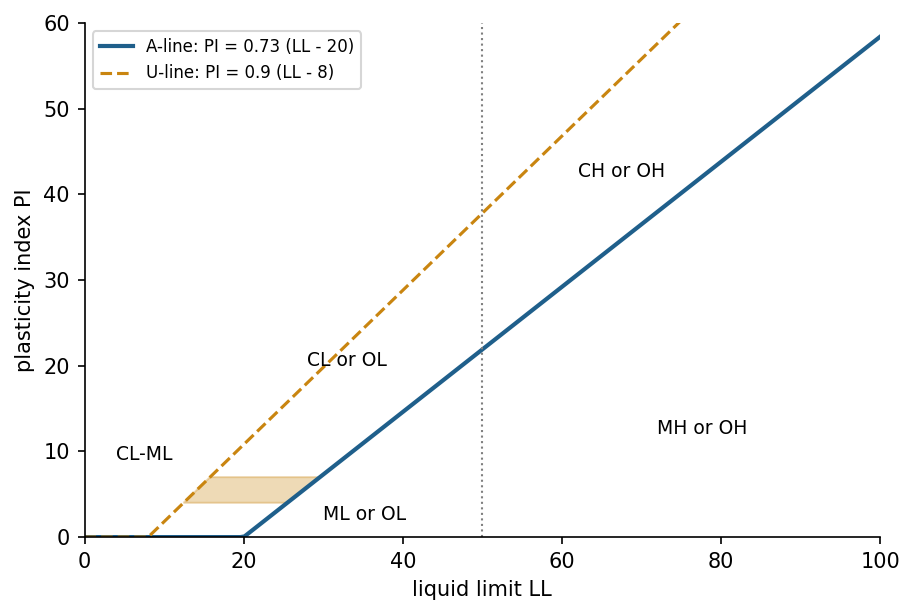
Check your understanding. A fine-grained soil has LL = 38 and PI = 18. The A-line value at LL = 38 is 0.73 x 18 = 13.1. What is its group symbol?
Strengths and limits
Knowledge-based systems are transparent, can be verified rule by rule, need no training data, and encode requirements that must hold exactly, such as the limits of a standard. They are brittle outside the cases their authors anticipated, they are expensive to acquire and maintain, and they cannot perceive raw signals or images. Modern practice therefore combines them with learning: A convolutional network may detect a crack, and a rule base derived from a code decides whether the crack width requires repair. Such hybrid systems return in later weeks, for example when a language model retrieves passages from standards in Week 13.
Python step 3: Dictionaries and functions
The Python step of this week is part of the Colab notebook, where every explanation stands next to a cell that runs it and the step closes with a quick check and exercises with immediate feedback. The printable lecture notes contain the same step together with the outputs of its code.
Review cards
Select a card to turn it over.
Continue the week
The week continues with the simulation and the self-assessment of the interactive lab and with the Python step and the hands-on work of the Colab notebook. The week overview lists the discipline challenges, the weekly task and the research assignment.
Interactive lab Colab notebook Self-assessment Week overview and tasks
References
[1] Giarratano, J. C., & Riley, G. D. (2005). Expert Systems: Principles and Programming (4th ed.). Thomson Course Technology.
[2] Lindsay, R. K., Buchanan, B. G., Feigenbaum, E. A., & Lederberg, J. (1993). DENDRAL: A case study of the first expert system for scientific hypothesis formation. Artificial Intelligence, 61(2), 209-261. https://doi.org/10.1016/0004-3702(93)90068-M
[3] Buchanan, B. G., & Shortliffe, E. H. (Eds.) (1984). Rule-Based Expert Systems: The MYCIN Experiments of the Stanford Heuristic Programming Project. Addison-Wesley.
[4] McDermott, J. (1982). R1: A rule-based configurer of computer systems. Artificial Intelligence, 19(1), 39-88. https://doi.org/10.1016/0004-3702(82)90021-2
[5] Hayes-Roth, F., Waterman, D. A., & Lenat, D. B. (Eds.) (1983). Building Expert Systems. Addison-Wesley.
[6] Russell, S., & Norvig, P. (2021). Artificial Intelligence: A Modern Approach (4th ed.). Pearson.
[7] Forgy, C. L. (1982). Rete: A fast algorithm for the many pattern/many object pattern match problem. Artificial Intelligence, 19(1), 17-37. https://doi.org/10.1016/0004-3702(82)90020-0
[8] Zadeh, L. A. (1965). Fuzzy sets. Information and Control, 8(3), 338-353. https://doi.org/10.1016/S0019-9958(65)90241-X
[9] Casagrande, A. (1948). Classification and identification of soils. Transactions of the American Society of Civil Engineers, 113, 901-930.
[10] ASTM International (2017). ASTM D2487-17: Standard Practice for Classification of Soils for Engineering Purposes (Unified Soil Classification System). ASTM International.