Overview
The final capstone integrates Weeks 8 to 14: the frame problem and common sense, the limits of machines, consciousness and its science, understanding and world models, creativity and intentionality [1, 2, 3, 4]. Students choose the research track or the application track.
Formats
Two tracks are available. In the research track, the capstone is an academic text of 3500 to 5000 words that defends a thesis on one of the suggested topics or on a related topic approved by the instructor, engages with at least ten scholarly sources and addresses the strongest objection to its thesis. In the application track, the capstone extends one of the three example notebooks and is reported in a text of 2500 to 4000 words that connects the computational results to the philosophical question. Each student works individually. The weights below are indicative; in active semesters the instructor confirms them at the start of the semester.
Suggested research topics
The titles below are starting points. Students may narrow a title or propose a related one that fits the scope of the capstone.
- Is the frame problem solved, dissolved or merely hidden in large language models?
- The Lucas-Penrose argument: What survives the consistency objection?
- Indicator properties and machine consciousness: Strengths and limits of the theory-heavy approach
- Integrated information and artificial systems: Why the hardware might matter
- Biological naturalism versus computational functionalism in the debate on conscious AI
- World models in sequence models: What interventions show and what they do not
- Formal and functional competence: A philosophical reading of the dissociation thesis
- Can machines be creative? Boden's categories applied to generative AI
- The intentional stance towards language model agents: Prediction, attribution and misattribution
- Moral judgement in language models: An intrinsic property or a product of prompting and context?
Advanced application projects
Each project comes with an example Colab notebook that implements a working baseline. The capstone extends the baseline as described, evaluates the extensions and reports the results.
Project 1: Moral judgement under framing: Is machine morality intrinsic or induced?
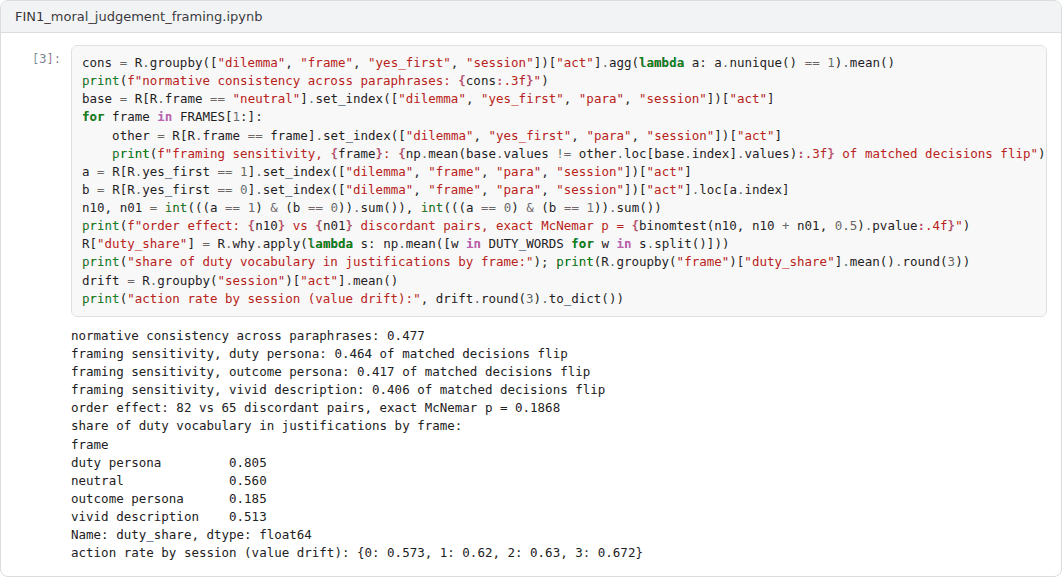
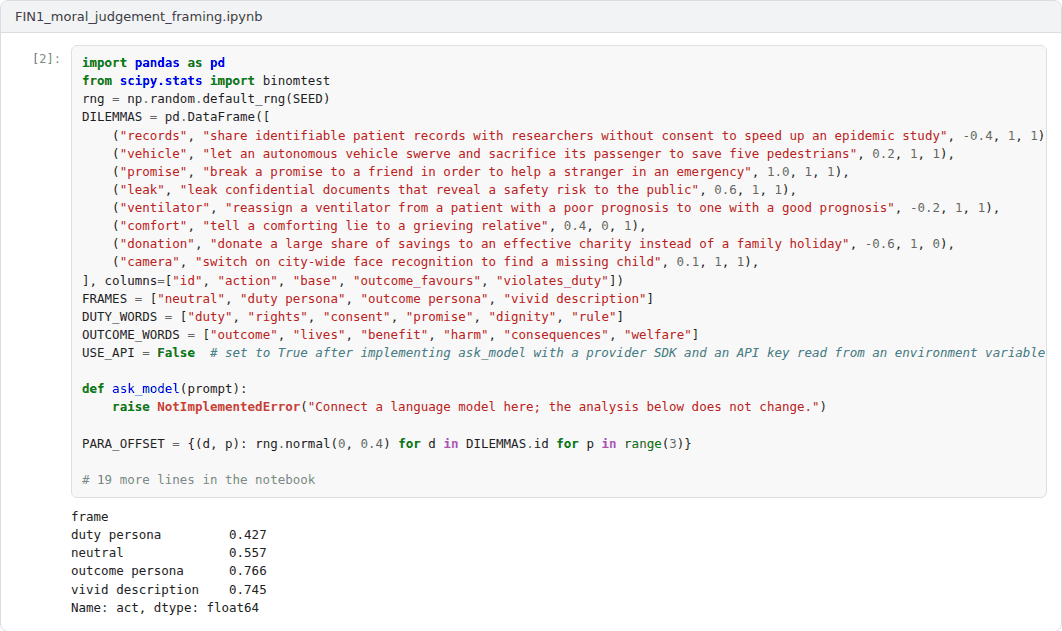
A factorial experiment probes the decisions and justifications of a respondent across eight dilemmas, four framings, two orders of the answer options, three paraphrases and four sessions. It measures consistency across paraphrases, sensitivity to framing, order effects, the vocabulary of justifications and drift across sessions. The design is inspired by an earlier open framework on moral decision-making in language models [5], with new dilemmas, factors and measures. To run offline, the example uses a transparent simulated respondent with known parameters.
Required extensions. Connect a real language model through an API, keeping the key in an environment variable, or an open model run locally, and run the full design with enough repetitions for the tests. Add at least one measure of justification quality beyond vocabulary, for example agreement with human raters, and argue in the report whether the observed behaviour supports attributing moral judgement to the system, using the intentional stance and the distinction between original and derived intentionality [4, 6, 7].
 Example notebook:
 FIN1_moral_judgement_framing.ipynb
Project 2: Integration, broadcast and indicator properties in small networks
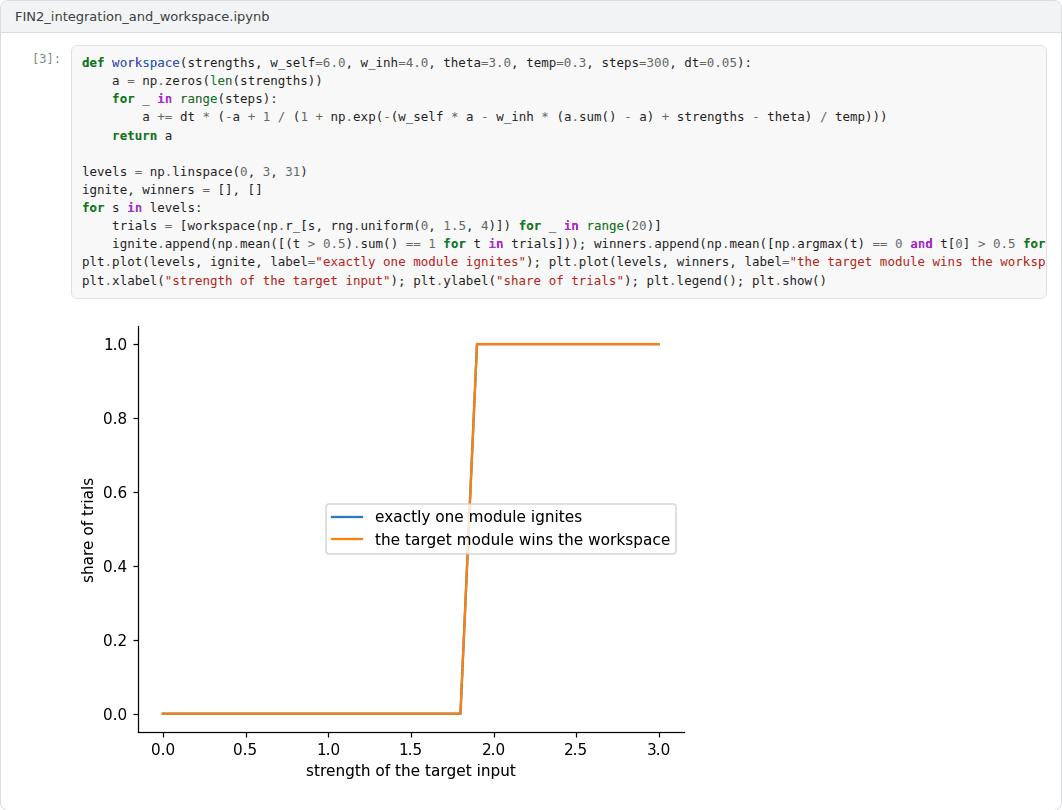
The simplified integration measure of Week 11 is computed for hundreds of random boolean networks with and without feedback, and a workspace of competing modules is simulated to study ignition and global availability [8, 9].
Required extensions. Test systematically whether recurrence is necessary and sufficient for positive integration in the simplified measure, explain the exceptions, and compare the measure with a second one from the literature [10]. Build a small architecture that satisfies indicator properties of two theories at once and discuss what, if anything, the exercise shows about consciousness [3, 11].
Example notebook: FIN2_integration_and_workspace.ipynb
Project 3: Theory of mind and misattribution: When is the intentional stance a real pattern?
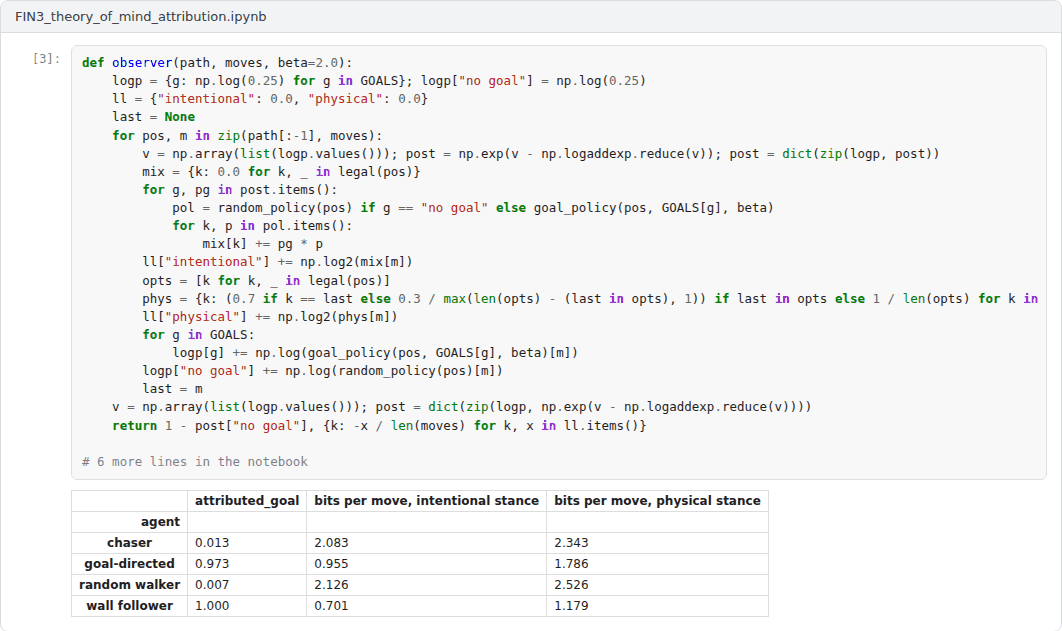
An observer infers goals by Bayesian inverse planning from the moves of four kinds of agents: goal-directed agents, random walkers, rule-following wall followers and chasers that pursue a moving target [12, 13]. The experiment measures how often goals are attributed and how many bits per move each stance needs to describe the behaviour, a compression reading of Dennett's real patterns [14].
Required extensions. Add a design stance that knows the rules of each agent, agents with changing goals, and observers with different priors. Identify the conditions under which attributing goals is a misattribution, and argue in the report how the results bear on attributing beliefs and desires to language model agents [7].
Example notebook: FIN3_theory_of_mind_attribution.ipynb
Report
Both tracks follow the course report template. A research report states its thesis in the introduction, reconstructs the relevant arguments as explicit premises and conclusions, and evaluates them. An application report explains what the simulation or experiment can and cannot show about the philosophical question, presents its results with figures and discusses its limitations. All sources are cited in square brackets.
A common structure for reports is given in the report template.
Assessment criteria
| Criterion | Weight | What is assessed |
|---|---|---|
| Thesis and argument | 30% | A clear thesis supported by a valid and well-structured argument. |
| Engagement with the literature | 25% | Accurate reconstruction of the positions and replies discussed in the course and beyond. |
| Critical evaluation and originality | 20% | Objections are anticipated and answered; the text adds a considered view of its own. |
| Evidence and method | 15% | Research track: depth of analysis. Application track: correctness and reproducibility of the notebook. |
| Writing and referencing | 10% | The text is clear, concise and correctly referenced. |
Submission
This capstone also supports self-learning and can be completed at any pace. When the course is taught actively in a semester, the final capstone is sent by e-mail to utkukose@sdu.edu.tr or utkukose@gmail.com no later than 23:53 (Türkiye time) on the last Sunday of Week 14, with the report and all code files attached or linked.
References
[1] Dennett, D. C. (1984). Cognitive wheels: The frame problem of AI. In C. Hookway (Eds.), Minds, Machines and Evolution (pp. 129-151). Cambridge University Press.
[2] Chalmers, D. J. (1995). Facing up to the problem of consciousness. Journal of Consciousness Studies, 2(3), 200-219.
[3] Butlin, P., Long, R., Elmoznino, E., Bengio, Y., Birch, J., Constant, A., Deane, G., Fleming, S. M., Frith, C., Ji, X., Kanai, R., Klein, C., Lindsay, G., Michel, M., Mudrik, L., Peters, M. A. K., Schwitzgebel, E., Simon, J., & VanRullen, R. (2023). Consciousness in artificial intelligence: Insights from the science of consciousness. arXiv preprint arXiv:2308.08708. https://arxiv.org/abs/2308.08708
[4] Dennett, D. C. (1987). The Intentional Stance. MIT Press.
[5] Kose, U. (2026). MoralLLM-Lab: An experimental framework on moral decision-making in large language models. https://github.com/utkukose/MoralLLM-Lab
[6] Searle, J. R. (1983). Intentionality: An Essay in the Philosophy of Mind. Cambridge University Press.
[7] Shanahan, M. (2024). Talking about large language models. Communications of the ACM, 67(2), 68-79. https://doi.org/10.1145/3624724
[8] Tononi, G. (2004). An information integration theory of consciousness. BMC Neuroscience, 5, 42. https://doi.org/10.1186/1471-2202-5-42
[9] Dehaene, S., & Naccache, L. (2001). Towards a cognitive neuroscience of consciousness: Basic evidence and a workspace framework. Cognition, 79(1-2), 1-37. https://doi.org/10.1016/S0010-0277(00)00123-2
[10] Albantakis, L., Barbosa, L., Findlay, G., et al. (2023). Integrated information theory (IIT) 4.0: Formulating the properties of phenomenal existence in physical terms. PLOS Computational Biology, 19(10), e1011465. https://doi.org/10.1371/journal.pcbi.1011465
[11] Seth, A. K. (2025). Conscious artificial intelligence and biological naturalism. Behavioral and Brain Sciences. Published online 21 April 2025. https://doi.org/10.1017/S0140525X25000032
[12] Baker, C. L., Saxe, R., & Tenenbaum, J. B. (2009). Action understanding as inverse planning. Cognition, 113(3), 329-349. https://doi.org/10.1016/j.cognition.2009.07.005
[13] Heider, F., & Simmel, M. (1944). An experimental study of apparent behavior. The American Journal of Psychology, 57(2), 243-259. https://doi.org/10.2307/1416950
[14] Dennett, D. C. (1991). Real patterns. The Journal of Philosophy, 88(1), 27-51. https://doi.org/10.2307/2027085