Vagueness and fuzzy sets
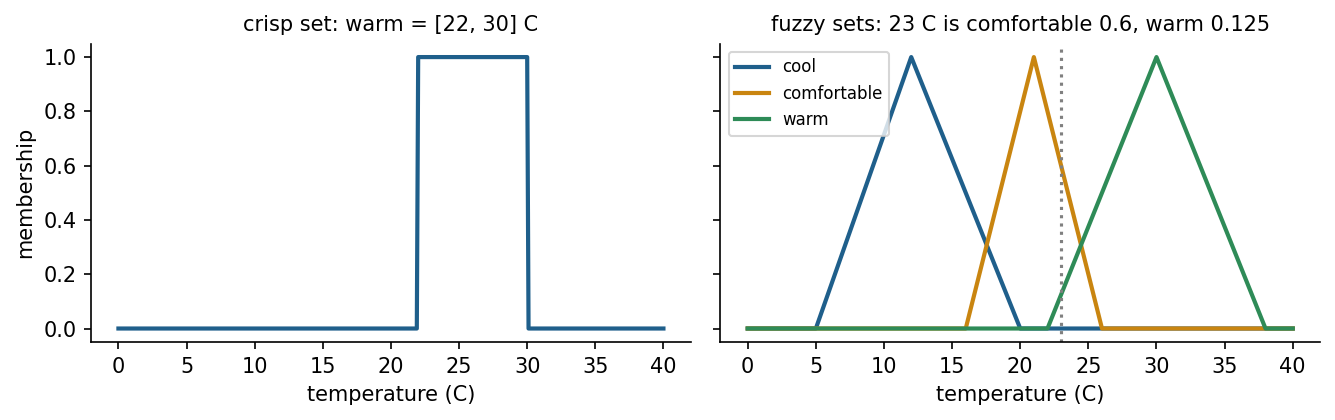
Week 3 ended with a weakness of crisp rules: A threshold of 70 degrees makes a reading of 69.9 normal and a reading of 70.1 overheated. Engineers rarely think in such steps. A temperature is more or less high, a load is fairly heavy, a surface is quite rough. Zadeh proposed fuzzy sets to represent such graded concepts [1]. A fuzzy set A on a universe of discourse X is defined by a membership function that assigns every element x a degree between 0 and 1. A room at 23 degrees may belong to the set of warm rooms with degree 0.6 and to the set of comfortable rooms with degree 0.4.
Vagueness is not probability. A membership degree of 0.6 does not say that the room is warm with probability 0.6. It says that 23 degrees fits the concept "warm" to degree 0.6, and there is nothing random about it. Probability describes uncertainty about whether an event happens; fuzzy membership describes how well a precisely known value fits an imprecise concept. The two can be combined, but they answer different questions.
Common membership functions are triangular, defined by a left foot, a peak and a right foot; trapezoidal, with a flat top; and Gaussian, with a centre and a width. The support of a fuzzy set is where its membership is positive, the core is where it equals one, and an alpha-cut is the crisp set of elements whose membership is at least alpha. A linguistic variable, such as tank level, takes linguistic values, such as low, okay and high, each represented by a fuzzy set on the same universe [2].
Check your understanding. A water temperature of 58 degrees has membership 0.7 in the fuzzy set "hot". What does this mean?
Operations on fuzzy sets
The classical set operations generalise. The complement NOT A has membership 1 minus the membership of A. The intersection A AND B is usually computed with the minimum of the two memberships, and the union A OR B with the maximum [1]. Other choices are possible: The product is also a valid intersection, called a t-norm, and the probabilistic sum a + b - ab is a valid union, called an s-norm. The choice changes the smoothness of the resulting controller but not the principle. Some classical laws fail on purpose: A AND NOT A need not be empty, because a temperature can be somewhat warm and somewhat not warm at the same time.
Mamdani inference
A fuzzy rule has linguistic conditions and a linguistic conclusion: IF level error is low AND level rate is none THEN valve change is open fast. Mamdani inference evaluates a rule base in five steps [3, 4]. First, fuzzification computes the membership of each crisp input in each of its fuzzy sets. Second, each rule receives a firing strength, the minimum of the memberships in its conditions. Third, implication clips the output fuzzy set of each rule at its firing strength. Fourth, aggregation combines the clipped sets of all rules with the maximum. Fifth, defuzzification turns the aggregated fuzzy set into one crisp output, most often with the centroid, the centre of gravity of the area under the aggregated membership function.
Animation: Inside a Mamdani controller
Move the two inputs of a tank level controller. The bars show fuzzification, the clipped shapes show the rules that fire, and the vertical line marks the centroid that becomes the valve command.
The controller defined by a rule base is a nonlinear function from inputs to output, and its control surface can be drawn for two inputs. Overlapping membership functions make the surface smooth; more sets and rules add detail. A rule table, with one input along the rows and the other along the columns, is the usual design tool: Every cell holds the conclusion for one combination of linguistic values, and gaps in the table leave parts of the input space without any action. Symmetry of the table usually leads to symmetric behaviour of the loop.
Check your understanding. Two rules fire with strengths 0.3 and 0.8 and conclude "open slow" and "open fast". What happens in Mamdani inference before defuzzification?
Takagi-Sugeno models and learning fuzzy systems
Takagi and Sugeno replaced the fuzzy conclusion by a function of the inputs: IF x is A AND y is B THEN z = p x + q y + r [5]. The output is the average of the rule outputs weighted by their firing strengths, so no defuzzification of a shape is needed. A zero-order Sugeno model has constant conclusions and behaves much like a Mamdani model with narrow output sets; a first-order model blends local linear models, which makes it attractive for modelling and for gain scheduling of controllers.
Because the Sugeno output is a differentiable function of its parameters, the parameters can be learned from data. ANFIS represents a Sugeno system as a five-layer adaptive network and trains the premise parameters with gradient descent and the linear consequent parameters with least squares [6]. Metaheuristic training is an alternative when gradients are unreliable: In one study, ANFIS supported by the vortex optimisation algorithm forecast chaotic electroencephalogram time series [7]. Such neuro-fuzzy systems link this week to the optimisation of Weeks 5 and 6 and to the neural networks of Week 10.
Check your understanding. What distinguishes a first-order Takagi-Sugeno rule from a Mamdani rule?
Fuzzy control in engineering
The first industrial success was the control of a cement kiln in Denmark, where operators' rules for burning zone temperature and oxygen were encoded as fuzzy rules [8]. The Sendai subway in Japan used predictive fuzzy control for automatic train operation, which improved riding comfort and stopping accuracy [9]. Fuzzy controllers later appeared in washing machines, cameras, heating systems, water treatment dosing and vehicle subsystems, and textbooks collect applications across civil, mechanical, chemical and electrical engineering [10].
Fuzzy control is most useful when a good mathematical model is missing but operator experience exists, when the process is nonlinear, and when smooth, explainable behaviour matters. It does not remove the need for analysis: Stability, robustness to disturbances and the effect of measurement noise must still be checked, for example by simulation over the operating range, as in the notebook. When a reliable model exists, classical or model-based control is often the better engineering choice.
Python step 4: NumPy arrays and first plots
The Python step of this week is part of the Colab notebook, where every explanation stands next to a cell that runs it and the step closes with a quick check and exercises with immediate feedback. The printable lecture notes contain the same step together with the outputs of its code.
Review cards
Select a card to turn it over.
Continue the week
The week continues with the simulation and the self-assessment of the interactive lab and with the Python step and the hands-on work of the Colab notebook. The week overview lists the discipline challenges, the weekly task and the research assignment.
Interactive lab Colab notebook Self-assessment Week overview and tasks
References
[1] Zadeh, L. A. (1965). Fuzzy sets. Information and Control, 8(3), 338-353. https://doi.org/10.1016/S0019-9958(65)90241-X
[2] Zadeh, L. A. (1973). Outline of a new approach to the analysis of complex systems and decision processes. IEEE Transactions on Systems, Man, and Cybernetics, SMC-3(1), 28-44. https://doi.org/10.1109/TSMC.1973.5408575
[3] Mamdani, E. H., & Assilian, S. (1975). An experiment in linguistic synthesis with a fuzzy logic controller. International Journal of Man-Machine Studies, 7(1), 1-13. https://doi.org/10.1016/S0020-7373(75)80002-2
[4] Lee, C. C. (1990). Fuzzy logic in control systems: Fuzzy logic controller, Part I. IEEE Transactions on Systems, Man, and Cybernetics, 20(2), 404-418. https://doi.org/10.1109/21.52551
[5] Takagi, T., & Sugeno, M. (1985). Fuzzy identification of systems and its applications to modeling and control. IEEE Transactions on Systems, Man, and Cybernetics, SMC-15(1), 116-132. https://doi.org/10.1109/TSMC.1985.6313399
[6] Jang, J.-S. R. (1993). ANFIS: Adaptive-network-based fuzzy inference system. IEEE Transactions on Systems, Man, and Cybernetics, 23(3), 665-685. https://doi.org/10.1109/21.256541
[7] Kose, U., & Arslan, A. (2017). Forecasting chaotic time series via ANFIS supported by vortex optimization algorithm: Applications on electroencephalogram time series. Arabian Journal for Science and Engineering, 42(8), 3103-3114. https://doi.org/10.1007/s13369-016-2279-z
[8] Holmblad, L. P., & Østergaard, J.-J. (1982). Control of a cement kiln by fuzzy logic. In Fuzzy Information and Decision Processes (M. M. Gupta & E. Sanchez, Eds.) (pp. 389-399). North-Holland.
[9] Yasunobu, S., & Miyamoto, S. (1985). Automatic train operation system by predictive fuzzy control. In Industrial Applications of Fuzzy Control (M. Sugeno, Ed.) (pp. 1-18). North-Holland.
[10] Ross, T. J. (2017). Fuzzy Logic with Engineering Applications (4th ed.). Wiley.