Text as engineering data
A large share of engineering knowledge is written: standards and codes, design reports, maintenance and incident logs, requirements, patents and source code. Natural language processing turns such text into data. Classic tasks include search and retrieval, classification of reports, extraction of quantities and entities, summarisation and translation. Information retrieval developed many of the tools, such as term weighting and vector space models, long before neural networks [1]. Large language models add the ability to generate text and code, which changes how engineers draft, search and program, and raises new questions about accuracy and responsibility.
From words to vectors
A model first splits text into tokens. Whole words give huge vocabularies and fail on new words; single characters make sequences long. Byte-pair encoding starts from characters and repeatedly merges the most frequent adjacent pair into a new symbol, so that common words become single tokens while rare words split into meaningful pieces [2]. Each token is then mapped to a vector, its embedding. Word2vec showed that embeddings learned from co-occurrence capture semantic relations, so that words used in similar contexts receive similar vectors [3]. Sentence embeddings extend the idea to whole passages and support semantic search [4].
Attention and the transformer
Attention was introduced to let a translation model look at the relevant words of the source sentence while producing each output word [5]. The transformer made attention the central operation [6]. Every token produces a query, a key and a value vector through learned linear maps. The attention weights of a token are the softmax of the dot products of its query with all keys, divided by the square root of the key dimension; its output is the weighted sum of the values. Several attention heads run in parallel and learn different relations, positional encodings inject word order, and residual connections and layer normalisation, as in the ResNets of Week 11, keep deep stacks trainable.
Two families dominate. Encoder models such as BERT see the whole text at once and are pretrained to fill in masked words, which suits classification and extraction [7]. Decoder models such as GPT are pretrained to predict the next token from the previous ones, with a causal mask that hides the future, and generate text one token at a time [8, 9]. Transformers now process images, sequences of measurements and molecules as well [10, 11].
Animation: Where does each token look?
Select a token of the sentence to see its attention weights over the others. The embeddings here are small hand-made vectors, chosen for illustration rather than learned; the temperature scales the dot products before the softmax.
Check your understanding. In scaled dot-product attention, why are the dot products divided by the square root of the key dimension?
Large language models
A language model assigns probabilities to the next token. Trained on hundreds of billions of tokens, decoder transformers develop broad abilities, and performance improves predictably with model size, data and compute, as empirical scaling laws describe [12]. GPT-3 showed that a large model can perform new tasks from a few examples in the prompt, without changing its weights [9]. Instruction tuning and reinforcement learning from human feedback then align models with what users ask for [13]. Prompts that ask for intermediate reasoning steps improve performance on multi-step problems [14], and models trained on code write and explain programs [15]. Such broadly trained models, adapted to many tasks, are called foundation models [16].
Generation samples tokens from the predicted distribution. A temperature below one sharpens the distribution towards the most likely tokens; a temperature above one flattens it and increases variety and the risk of nonsense. The model has no built-in notion of truth: It produces what is probable given its training, and fluent but unsupported statements, called hallucinations, are a known failure mode [17]. For an engineer, a model's answer about a load factor or a material property is a hypothesis to check, never a source.
Check your understanding. A model's next-token logits are 2.0, 1.0 and 0.0. What happens to the probability of the first token when the temperature is lowered from 1.0 to 0.5?
Retrieval-augmented generation
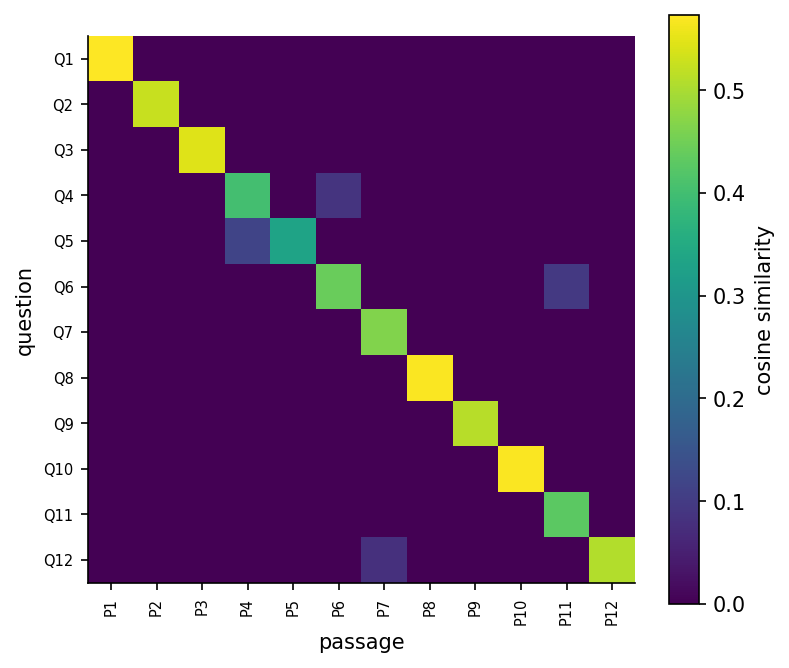
Retrieval-augmented generation combines a retriever with a generator [18]. The retriever searches a document collection, for example a company's standards or a project's reports, for passages relevant to the question. The generator then answers using those passages and can cite them. Grounding reduces hallucination, keeps answers current without retraining, and lets a reader verify each claim against its source. Retrieval can use sparse term weighting such as TF-IDF [1] or dense sentence embeddings [4]. Its quality can be measured like any classifier: For a set of questions with known relevant passages, the share of questions whose relevant passage appears among the top results is the hit rate.
Check your understanding. What is the main engineering benefit of retrieval-augmented generation over asking a model directly?
Generative models beyond text
Variational autoencoders learn a latent space from which new samples can be decoded [19]. Generative adversarial networks train a generator against a discriminator that tries to tell real from generated data [20]. Diffusion models learn to reverse a gradual noising process and now produce high-quality images; latent diffusion runs the process in a compressed space to make it efficient [21, 22]. In engineering, generative models propose designs, create synthetic training images for rare defects, and suggest candidate materials; deep learning has proposed hundreds of thousands of stable crystal structures [23], and language models have planned and run chemistry experiments with robotic equipment [24]. Every generated design still has to satisfy the physics, the codes and the tests.
Responsible use in engineering work
Engineers remain accountable for their work, whatever tools they use. Four rules follow. Verify every factual or numerical claim against a primary source, a calculation or a test. Do not paste confidential designs, personal data or unpublished results into external services unless the organisation's policy allows it. Cite the sources that support the work, not the tool. And treat model inputs as an attack surface: Instructions hidden in documents can manipulate a model that reads them, and small perturbations can change the decisions of learned models [25]. The energy cost of training and running large models is also part of the engineering trade-off [26]. The course policy on the use of these tools is stated in the syllabus.
Python step 13: Text, vectors and attention
The Python step of this week is part of the Colab notebook, where every explanation stands next to a cell that runs it and the step closes with a quick check and exercises with immediate feedback. The printable lecture notes contain the same step together with the outputs of its code.
Review cards
Select a card to turn it over.
Continue the week
The week continues with the simulation and the self-assessment of the interactive lab and with the Python step and the hands-on work of the Colab notebook. The week overview lists the discipline challenges, the weekly task and the research assignment.
Interactive lab Colab notebook Self-assessment Week overview and tasks
References
[1] Manning, C. D., Raghavan, P., & Schütze, H. (2008). Introduction to Information Retrieval. Cambridge University Press.
[2] Sennrich, R., Haddow, B., & Birch, A. (2016). Neural machine translation of rare words with subword units. In Proceedings of the 54th Annual Meeting of the Association for Computational Linguistics (pp. 1715-1725). https://doi.org/10.18653/v1/P16-1162
[3] Mikolov, T., Chen, K., Corrado, G., & Dean, J. (2013). Efficient estimation of word representations in vector space. arXiv preprint arXiv:1301.3781. https://arxiv.org/abs/1301.3781
[4] Reimers, N., & Gurevych, I. (2019). Sentence-BERT: Sentence embeddings using Siamese BERT-networks. In Proceedings of EMNLP-IJCNLP 2019 (pp. 3982-3992). https://doi.org/10.18653/v1/D19-1410
[5] Bahdanau, D., Cho, K., & Bengio, Y. (2015). Neural machine translation by jointly learning to align and translate. In 3rd International Conference on Learning Representations (ICLR 2015). https://arxiv.org/abs/1409.0473
[6] Vaswani, A., Shazeer, N., Parmar, N., Uszkoreit, J., Jones, L., Gomez, A. N., Kaiser, Ł., & Polosukhin, I. (2017). Attention is all you need. In Advances in Neural Information Processing Systems 30 (pp. 5998-6008). https://arxiv.org/abs/1706.03762
[7] Devlin, J., Chang, M.-W., Lee, K., & Toutanova, K. (2019). BERT: Pre-training of deep bidirectional transformers for language understanding. In Proceedings of NAACL-HLT 2019 (pp. 4171-4186). https://doi.org/10.18653/v1/N19-1423
[8] Radford, A., Wu, J., Child, R., Luan, D., Amodei, D., & Sutskever, I. (2019). Language models are unsupervised multitask learners. OpenAI.
[9] Brown, T. B., Mann, B., Ryder, N., et al. (2020). Language models are few-shot learners. In Advances in Neural Information Processing Systems 33 (pp. 1877-1901). https://arxiv.org/abs/2005.14165
[10] Dosovitskiy, A., Beyer, L., Kolesnikov, A., et al. (2021). An image is worth 16x16 words: Transformers for image recognition at scale. In 9th International Conference on Learning Representations (ICLR 2021). https://arxiv.org/abs/2010.11929
[11] Mousavi, S. M., Ellsworth, W. L., Zhu, W., Chuang, L. Y., & Beroza, G. C. (2020). Earthquake transformer: An attentive deep-learning model for simultaneous earthquake detection and phase picking. Nature Communications, 11, 3952. https://doi.org/10.1038/s41467-020-17591-w
[12] Kaplan, J., McCandlish, S., Henighan, T., et al. (2020). Scaling laws for neural language models. arXiv preprint arXiv:2001.08361. https://arxiv.org/abs/2001.08361
[13] Ouyang, L., Wu, J., Jiang, X., et al. (2022). Training language models to follow instructions with human feedback. In Advances in Neural Information Processing Systems 35 (pp. 27730-27744). https://arxiv.org/abs/2203.02155
[14] Wei, J., Wang, X., Schuurmans, D., et al. (2022). Chain-of-thought prompting elicits reasoning in large language models. In Advances in Neural Information Processing Systems 35 (pp. 24824-24837). https://arxiv.org/abs/2201.11903
[15] Chen, M., Tworek, J., Jun, H., et al. (2021). Evaluating large language models trained on code. arXiv preprint arXiv:2107.03374. https://arxiv.org/abs/2107.03374
[16] Bommasani, R., Hudson, D. A., Adeli, E., et al. (2021). On the opportunities and risks of foundation models. arXiv preprint arXiv:2108.07258. https://arxiv.org/abs/2108.07258
[17] Ji, Z., Lee, N., Frieske, R., et al. (2023). Survey of hallucination in natural language generation. ACM Computing Surveys, 55(12), 248. https://doi.org/10.1145/3571730
[18] Lewis, P., Perez, E., Piktus, A., et al. (2020). Retrieval-augmented generation for knowledge-intensive NLP tasks. In Advances in Neural Information Processing Systems 33 (pp. 9459-9474). https://arxiv.org/abs/2005.11401
[19] Kingma, D. P., & Welling, M. (2014). Auto-encoding variational Bayes. In 2nd International Conference on Learning Representations (ICLR 2014). https://arxiv.org/abs/1312.6114
[20] Goodfellow, I., Pouget-Abadie, J., Mirza, M., et al. (2014). Generative adversarial nets. In Advances in Neural Information Processing Systems 27 (pp. 2672-2680). https://arxiv.org/abs/1406.2661
[21] Ho, J., Jain, A., & Abbeel, P. (2020). Denoising diffusion probabilistic models. In Advances in Neural Information Processing Systems 33 (pp. 6840-6851). https://arxiv.org/abs/2006.11239
[22] Rombach, R., Blattmann, A., Lorenz, D., Esser, P., & Ommer, B. (2022). High-resolution image synthesis with latent diffusion models. In 2022 IEEE/CVF Conference on Computer Vision and Pattern Recognition (CVPR) (pp. 10684-10695). https://doi.org/10.1109/CVPR52688.2022.01042
[23] Merchant, A., Batzner, S., Schoenholz, S. S., et al. (2023). Scaling deep learning for materials discovery. Nature, 624(7990), 80-85. https://doi.org/10.1038/s41586-023-06735-9
[24] Boiko, D. A., MacKnight, R., Kline, B., & Gomes, G. (2023). Autonomous chemical research with large language models. Nature, 624(7992), 570-578. https://doi.org/10.1038/s41586-023-06792-0
[25] Kose, U. (2019). Techniques for adversarial examples threatening the safety of artificial intelligence based systems. In I. International Science and Innovation Congress (INSI Congress 2019). Pamukkale, Denizli, Türkiye. https://arxiv.org/abs/1910.06907
[26] Strubell, E., Ganesh, A., & McCallum, A. (2019). Energy and policy considerations for deep learning in NLP. In Proceedings of the 57th Annual Meeting of the Association for Computational Linguistics (pp. 3645-3650). https://doi.org/10.18653/v1/P19-1355